

On the scene
When a sudden illness or accident occurs, police are often the first to respond. But as a skilled EMT-Paramedic, you’ll quickly follow and take over the care of the patient.
After the patient is stabilized, you’ll continue to monitor vitals and respond to their medical needs as they’re transported by an Advanced Life Support unit to the hospital and waiting doctors and nurses.
It’s a work environment that is adrenalin-charged and fast paced, and your paramedic training will often mean the difference between life and death.
For a look at all the courses in our program, consult the course list.
Get Started Ask Admissions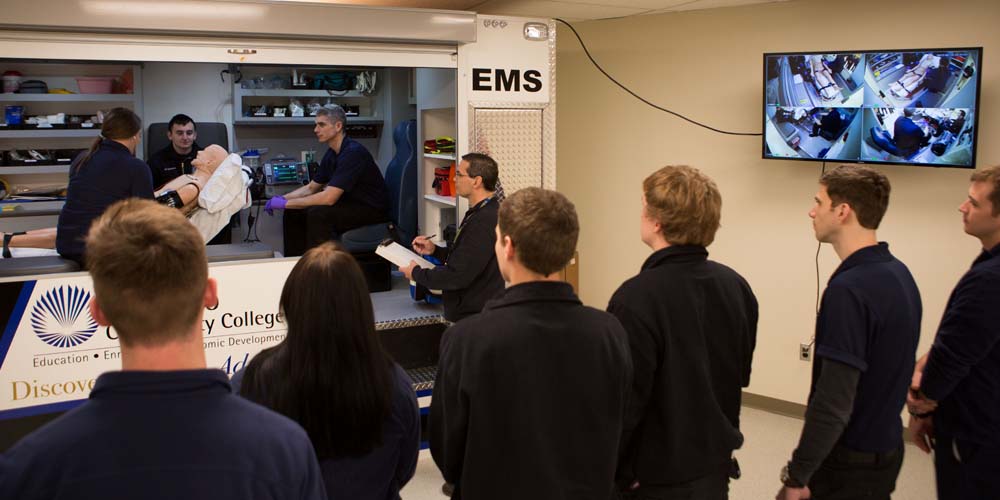
Fire chiefs’ first choice
Our faculty know what it’s like to save someone’s life.
As working or retired paramedics they’ve done it many times. They’ll teach you about:
- Paramedic procedures
- Emergency management
- Pharmacology
- And much more!
There are also EMT and hospital clinicals that will give you hands-on experience in the field. The College Catalog provides a complete look at what the program consists of.
Our program will also prepare you to take the National Registry Examination and provides you with credits that transfer if you want to continue on toward a bachelor’s degree.
With our expert faculty and advanced training facilities, our program is the first choice of all emergency medical service providers in Michigan and is endorsed by the Macomb County Fire Chiefs Association!
Ready to get started?
Program Coordinator Erin Donathan, 586.286.2069, can fill you in with more details, including the Selective Admissions process required for all Health and Human Services programs.
A skills ladder
All of these skills are in great demand and the tool below shows the positions and salaries available with an associate degree from Macomb, as well as with a bachelor’s degree if you decide to continue your education at a four-year college or university.
While you’ll likely be recruited by a fire department right out of the program, our Career Services team is also here to help you with job search and resume and interview-preparation.
Additional Information
Select programs in Health and Human Services require specific criteria to gain admission, such as testing requirements or minimum grade point average in prerequisite courses. Please view the Selective Admissions program application packet for information on application requirements, ranking and deadlines.
For information on how to apply to a Selective Admissions program, please email us at selectiveadmissions@macomb.edu. Selective Admissions applicants are encouraged to meet with an academic advisor or counselor prior to submitting an application to the program. This meeting will allow for review of the application process, program prerequisites and requirements. Contact the Counseling and Academic Advising Office at 586.445.7999 for office hours.
Transfer of Credits/Advanced Placement and Experiential Learning
- Transfer of Credits- Macomb Community College does not accept transfer credits for the paramedic program.
- Macomb Community College EMS Program does not participate in Advanced Placement or Experiential Learning.
In Macomb’s Emergency Medical Technician - Paramedic program, you will learn how to take over the care of victims of sudden illness or accident from first responders on the scene and obtain the skills and knowledge necessary to staff sophisticated Advanced Life Support Units. The Emergency Medical Technician - Paramedic program prepares you to take the National Registry Examination.
CAAHEP Accredited Paramedic Programs and CoAEMSP Letter of Review (LoR) Programs track and report outcome measures annually to the Committee on Accreditation for the Emergency Medical Services Professions (CoAEMSP). The most current CoAEMSP Annual Report was for the calendar year 2023.
Pass rate indicates success on the National Registry of EMT Paramedic/State Cognitive exam. Positive placement is defined by the CoAEMSP as ‘Employed full or part-time in a related field and/or continuing his/her education and/or serving in the military’. Positive placement is measured at completion of the program.
| Class Graduating | Retention | Pass Rate | Work Placement (New) |
|---|---|---|---|
| 2025 | 86% | 82% | N/A |
| 2024 | 91% | 62% | 79% |
| 2023 | 91.7% | 71.4% | 36.4% |
| 2022 | 78.6% | 77.3% | 27.3% |
The Paramedic Program is accredited by the Commission on Accreditation of Allied Health Education Programs (www.caahep.org) upon the recommendation of the Committee on Accreditation of Educational Programs for the Emergency Medical Services Professions (CoAEMSP).
Commission on Accreditation of Allied Health Education Programs
9355 - 113th St. N, #7709
Seminole, FL 33775
Phone: 727.210.2350
www.caahep.org
To contact CoAEMSP:
8301 Lakeview Parkway
Suite 111-312
Rowlett, TX 75088
Phone: 214.703.8445
Fax: 214.703.8992
www.coaemsp.org
A technical standard is a set of essential abilities and skills required for individuals to successfully perform the duties of a specific profession. In the context of EMS education, technical standards define the physical, cognitive, sensory, and behavioral competencies necessary for students to meet the demands of paramedic training and professional practice. These standards ensure that students can safely and effectively perform required tasks with or without reasonable accommodations while maintaining patient care quality and adhering to legal and ethical guidelines. Those technical standards include:
Motor and Physical Abilities
- Lift, carry, push, and pull a minimum of 125 lbs. independently and 250 lbs. with assistance.
- Perform prolonged physical activity, including standing, walking, climbing, kneeling, bending, and balancing.
- Operate emergency vehicles safely under various conditions.
- Perform fine and gross motor movements, including hand-eye coordination and manual dexterity, for procedures such as intubation, IV insertion, and medication administration.
Sensory Abilities
- Have sufficient visual acuity to read small print, assess skin color changes, and detect movement.
- Have adequate hearing to communicate effectively in noisy environments and detect alarms or distress calls.
- Possess tactile ability for palpation and physical assessment.
Cognitive and Problem-Solving Skills
- Quickly assess, analyze, and synthesize complex medical information in high-pressure situations.
- Apply sound clinical judgment and critical thinking to patient care.
- Interpret and apply medical protocols, standing orders, and physician directives.
- Adapt to rapidly changing environments and patient conditions.
Communication Skills
- Communicate effectively in English, both verbally and in writing, with patients, families, and healthcare providers.
- Document patient care accurately and efficiently in electronic or written formats.
- Interpret and follow verbal and written instructions in emergency situations.
Behavioral and Emotional Stability
- Maintain emotional control and professionalism in high-stress, traumatic, and life-threatening situations.
- Demonstrate compassion, integrity, and ethical decision-making.
- Work effectively in a team environment and interact professionally with diverse populations.
- Manage exposure to death, suffering, and unpredictable situations while maintaining focus on patient care.
Environmental and Safety Considerations
- Function in extreme environments, including exposure to heat, cold, rain, snow, and hazardous materials.
- Follow infection control protocols and use personal protective equipment (PPE) to minimize exposure to pathogens.
- Recognize and mitigate safety risks for self, patients, and team members.
Professionalism and Ethical Conduct
- Adhere to legal and ethical standards of the EMS profession.
- Maintain patient confidentiality and comply with HIPAA regulations.
- Accept constructive feedback and demonstrate a commitment to lifelong learning.
SPECIAL SERVICES STATEMENT: Students may individually discuss the essential functions and technical standards with a college counselor from our Special Services department. In compliance with Section 504 of the Rehabilitation Act of 1973 and the American Disability Act of 1991, academic accommodations may be provided to students who have a documented disability. For further information, visit Special Services.