

Your Future in Focus.
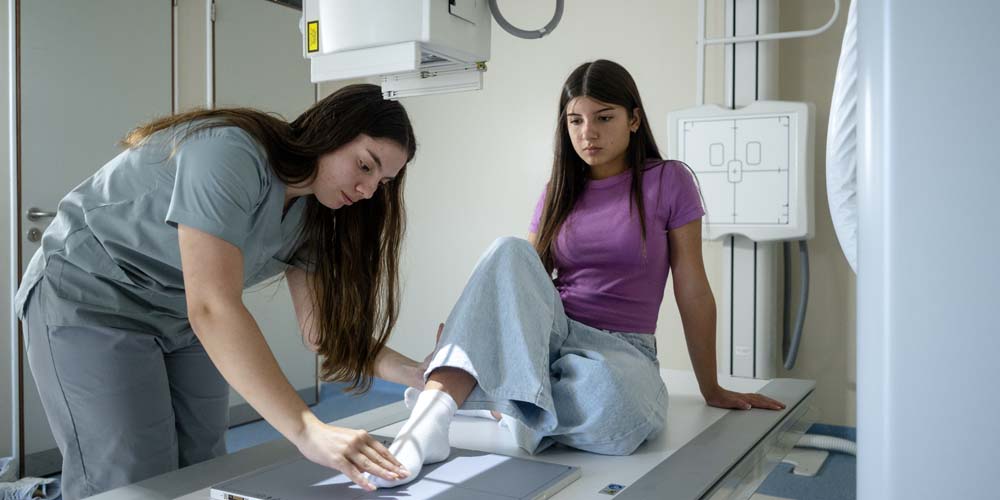
Every day, X-ray imaging saves lives. These powerful images allow doctors and healthcare professionals to see inside the body, diagnose injuries and illness and guide life-changing treatment.
In our Radiology Technology program, you’ll learn how to create these images. Through classroom instruction, personal mentoring and hands-on clinical experience, we’ll help you become a confident Registered Radiologic Technologist ready to work in health care settings.
You’ll develop strong radiologic knowledge, critical thinking skills and professional values through hands-on training, ethical guidance and a strong focus on patient care and clinical excellence.
Our program consists of hands-on learning in our classrooms and at area hospitals. For more information, please view the Radiologic Technology Course Guide.
Employment of radiologic technologists is projected to grow about 5% faster than other occupations. - U.S. Department of Labor Statistics
Ready to take the next step?
Contact Connie Peters at 586.226.4760 for help getting started.
A demand for technologists
With an aging population, the need for radiologic technologists has never been greater.
Use this handy tool to see what’s available locally and what you can expect to earn.
And if you aren’t recruited by a hospital by the time you graduate, Career Services can help you find your first job.
Additional Information
The goal of the Health and Public Services Division is to prepare every student to think critically and practice competently and compassionately in rapidly changing environments. All efforts are designed to build knowledge, enhance practical skills, and promote patient and the population’s safety. Furthermore, the program is designed to foster professional integrity and ultimately improve the health outcomes and protection of patients, families, and communities across the continuum of care and practice. Students must possess certain functional abilities, essential for the delivery of safe, effective clinical care and protection of the public during clinical and internship training activities in the field. Therefore, the faculty has determined that certain technical standards are required for admission to, progression in, and graduation from the Health and Public Services (HPS) programs.
In addition to classroom learning, clinical and internship learning occurs throughout the HPS programs and involves considerations (such as patient and population safety and clinical and internship facility safety) that are not present in classroom accommodations. Applicants or students interested in HPS programs who seek accommodations prior to or immediately after enrolling in the college are highly encouraged to also request an assessment of the types of reasonable accommodations needed for the clinical and or internship components of the program.
An individual must be able to independently, with or without reasonable accommodation, meet the following technical standards of general abilities: (1) observation; (2) communication; (3) motor skills; (4) intellectual, conceptual, and quantitative abilities; (5) essential behavioral and social attributes; and (6) ability to manage stressful situations. Individuals unable to meet these technical standards, with or without reasonable accommodation will not be able to complete the programs and are counseled to pursue alternative careers.
SPECIAL SERVICES STATEMENT: Students may individually discuss the essential functions and technical standards with a college counselor from our Special Services department. In compliance with Section 504 of the Rehabilitation Act of 1973 and the American Disability Act of 1991, academic accommodations may be provided to students who have a documented disability.
For further information, visit Special Services.
Once you have completed the prerequisite courses, fill out Macomb’s application for entry into the program before Feb. 1 of the year you want to attend.
You will then apply for acceptance at one of the collaborating Joint Review Committee on Education in Radiology Technology (JRCERT) health care facilities to complete the 24-month hospital-based clinical and didactic (classroom) components of the degree to earn a block of 30 semester credits. Acceptance into the program is not automatic and is highly selective based on successful completion of individual health care facilities’ admission requirements. Upon transfer to the hospital-based program, your financial aid eligibility changes. We encourage you to meet with someone in our Financial Aid office to discuss these changes.
Please be aware that the program requires clinical coursework, which is usually eight hours per day and can range from a minimum of 24 to a maximum of 40 hours a week. Clinical rotations are not limited to one site. Vacation periods are scheduled intermittently during the year by the individual health care facility, which may not coincide with Macomb’s schedule of vacations. For specific details of each program and their respective admissions requirements, please visit the websites of the collaborating health care partners: Henry Ford St. John Hospital, Henry Ford Providence Hospital, Southfield Campus and DMC/Sinai Grace Hospital.
Prerequisite courses you’ll take at Macomb:
- English
- Medical Terminology
- Computer & Information Processing
- Human Physiological Anatomy
- Physical Science
- Intermediate Algebra
- Introductory Psychology
- Introduction to Ethics
All the credits you earn in our program will transfer if you decide to pursue a bachelor’s degree for further career advancement.
Upon completion of this program, students will be able to be:
Goal 1 - Clinically competent
1.1 Students will demonstrate appropriate positioning skills.
1.2 Students will demonstrate and practice radiation protection skills using the ALARA Principles.
Goal 2 - Demonstrate effective communication skills
2.1 Students will practice oral and written communication skills in the educational setting.
2.2 Students will practice communication skills in the clinical setting.
Goal 3 - Utilize critical thinking and problem-solving skills
3.1 Students will use critical thinking and problem-solving skills in the
clinical setting: by performing radiographic exams both routine and special views.
3.2 Students will use critical thinking skills and problem-solving skills in the didactic setting.
Goal 4 - Demonstrate professional and ethical behaviors
4.1 Students will exhibit behaviors that model professionalism within the didactic and clinical setting.
4.2 Students will recognize the importance of continued professional development.
For information on how to apply to a Selective Admissions program, please email us at selectiveadmissions@macomb.edu. Selective Admissions applicants are encouraged to meet with an academic advisor or counselor prior to submitting an application to the program. This meeting will allow for review of the application process, program prerequisites and requirements. Contact the Counseling and Academic Advising Office at 586.445.7999 for office hours.